London to Pearson & the airports · 2026-09-21 · 8-minute read
The London to Pearson run in winter crosses the lake-effect snow belt between Dorchester and Cambridge, where squalls off Lake Huron cross Highway 401 in bands that can turn a clear road into a whiteout in ten minutes; LondonLimo.net drives it with rules rather than hope - the Environment Canada forecast and the Ontario 511 cameras read the evening before, a pickup moved earlier by the desk when a squall is due, winter tires from November to April, an all-wheel-drive SUV dispatched when the forecast calls for it, a chauffeur who drives at the speed the road allows and stops when it allows none, and a desk that rebooks the flight and charges nothing on the one or two days a winter when the 401 closes outright. The London to Pearson page has the rules; this article is the winter in detail.
The snow belt, and where it lies on the run
Lake Huron's cold-season squalls form over the open water and blow southeast across Huron and Middlesex counties, crossing the 401 in a band that runs roughly from Dorchester to Cambridge - the first eighty kilometres of the run - and the Woodstock stretch is the worst of it: flat, open, and in the squalls' path. East of Cambridge the belt thins and the 401 through Milton and Mississauga is usually clear when Woodstock is white. The chauffeurs know the band by kilometre marker; the hour-by-hour article has the run's stages.
| Condition on the 401 | The desk's rule | What the passenger sees |
|---|---|---|
| Clear, cold, dry | Standard pickup: 3 h 40 before international, 3 h before domestic, plus 2 h | A normal run |
| Squall warning for Middlesex-Oxford overnight | Pickup 20-30 min earlier; SUV dispatched | An earlier text the evening before |
| Squall in progress at Woodstock at departure | Pickup 30-45 min earlier; 80 km/h through the band | A slower first hour; the margin intact |
| 401 closed between London and Cambridge | The run does not go; the desk calls; the travel desk rebooks | No charge for the attempt |
| Toronto snowstorm, London clear | Pickup 20 min earlier for the 401 through Mississauga; the 407 taken | A normal first hour; a slow last one |
The evening before: the forecast and the cameras
The desk reads the forecast for the corridor - the squall warnings for Middlesex, Oxford and Waterloo - and the cameras at Dorchester, Woodstock, Drumbo and Cambridge at 9 p.m. the evening before every winter Pearson run, and moves the pickup earlier when the morning looks white; the passenger gets a text: "Squall warning for Woodstock overnight; we will be at your door at 3:50 rather than 4:20." The rule is that the passenger is never asked to choose between an earlier pickup and a missed flight; the earlier pickup is booked and explained.
Winter tires, and the SUV
Every vehicle in the fleet is on winter tires from November to April, which is the difference between stopping and not on the 401's black ice; the executive SUVs are all-wheel drive and the desk dispatches one for a Pearson run when the forecast calls for it, at the SUV's fare if the passenger booked one and at the sedan's if the desk chose it. The fleet page describes the standard; the chauffeurs page the winter training.
The speed the road allows
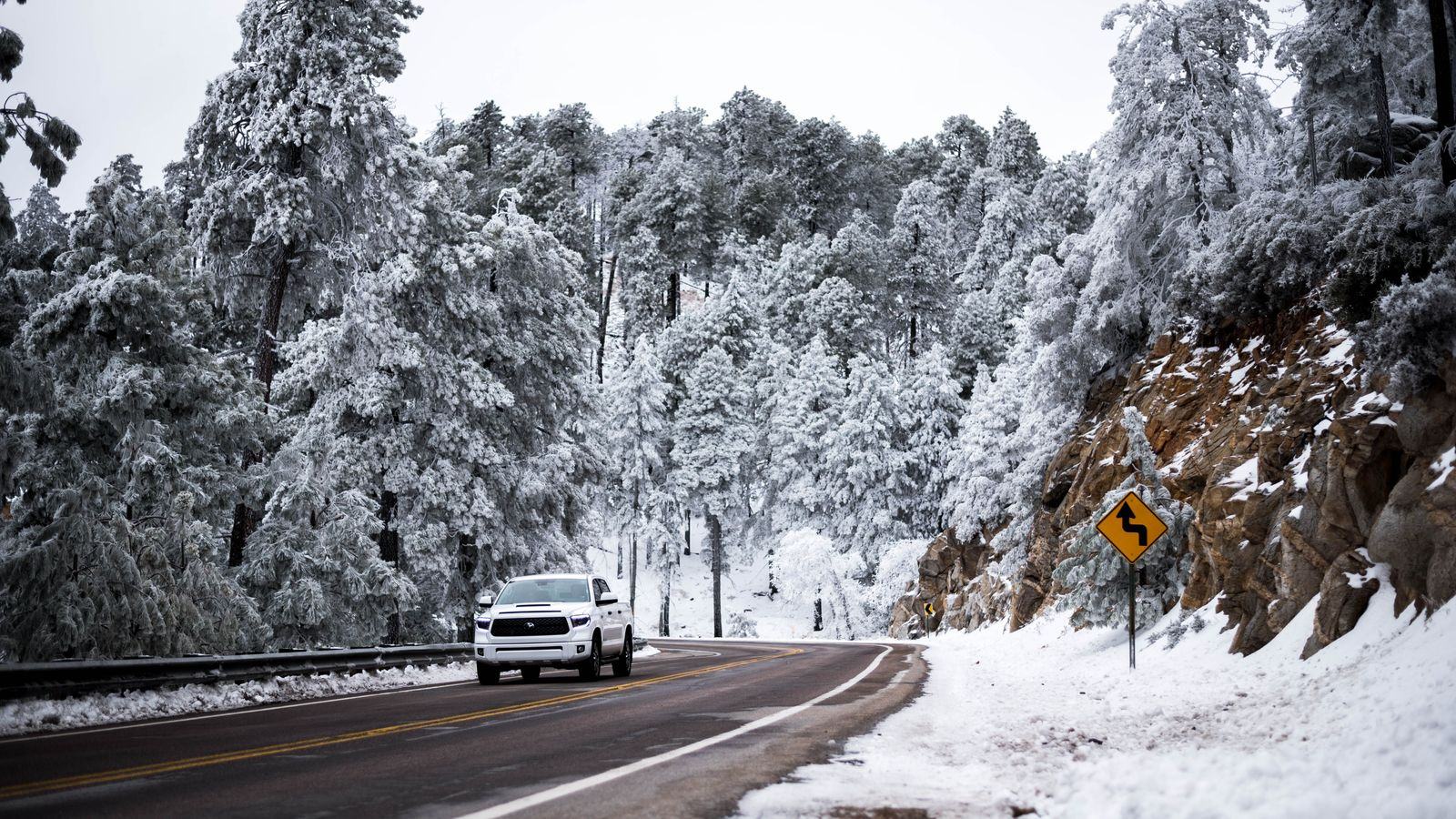
A chauffeur in a squall drives at 80, at 60, or at 40 as the road allows, in the right lane behind the plow when there is one, with the lights on and the following distance doubled; the passenger sees a slower first hour and the same terminal, because the earlier pickup bought the time. A chauffeur who judges the road unsafe pulls off at Ingersoll or Woodstock, calls the desk, and waits for the band to pass - squalls are bands, and twenty minutes at a service centre usually sees one through.
The day the run does not go
Once or twice a winter the Ministry of Transportation closes the 401 between London and Cambridge for a multi-vehicle collision or a whiteout, and nothing on rubber moves; the desk calls the passenger, the travel desk rebooks the flight, and no fare is charged for the attempt. The VIA train runs on those days, and a passenger who can reach London's station and Union is told so; the comparison guide has the train's case.
The Toronto end: the 407 in a storm
A Toronto snowstorm with London clear is the run's other winter: the first hour normal and the 401 through Mississauga a crawl; the chauffeur takes the 407 from Milton, which is plowed first and moves when the 401 does not, and the toll is inside the fare. The cost guide has the 407 inside the number.
The return in winter
A flight landing at Pearson into a storm is met by a chauffeur who drove up ahead of it on the desk's earlier-departure rule, waited in the hall, and drives home at the speed the road allows; the desk tells the passenger by text that the run home may be three hours rather than two, and the Pearson to London article describes the winter version.
What the family should expect
An earlier text the evening before; a warm SUV at the door with the engine running; a chauffeur who loads the bags while the children are carried out asleep; a slower first hour through Woodstock with the plow ahead; a normal second hour; the terminal with the margin intact; and, once or twice a winter, a call that the run cannot go and a flight rebooked at no charge. The airport limo page has the family routine.
Three winter runs, as they went
A Tuesday in January, squall warning, 9:30 a.m. flight to Cancun. The pickup moved from 3:50 to 3:20 by text the evening before; an SUV; 70 km/h through Woodstock behind a plow; Terminal 3 at 5:55 with the family's margin intact.
A Friday in February, 401 closed at Ingersoll at 5 a.m. The desk called at 4:40; the travel desk rebooked the passenger's Frankfurt flight to Saturday; no charge.
A Sunday in December, Toronto snowstorm, London clear. A normal first hour; the 407 from Milton; Terminal 1 at 6:10, twenty-five minutes ahead of the 401's estimate.
Booking it
The reservation engine sets the pickup from the flight and the desk moves it earlier when the forecast requires; the London to Pearson page has the rules in full, and the FAQ the winter questions.
Three questions the desk is asked about winter
How do you decide to move the pickup earlier? A squall warning for Middlesex, Oxford or Waterloo overnight, or a camera at Woodstock showing snow on the lanes at 9 p.m., moves a morning pickup by twenty to forty-five minutes; the desk texts the reason. Can I refuse the earlier pickup? Yes - the desk notes on the confirmation that the margin is the passenger's, and the fare does not change either way. What about the return in a storm? The chauffeur drives up ahead of the storm on the earlier-departure rule, waits in the hall, and drives home at the road's speed; the desk texts that the run may take three hours.
The other winter roads on this site
The 402 to Sarnia and the Huron shore takes the squalls first; the 401 west to Windsor drifts on the flattest land in the province; the 403 through Brantford to Hamilton is the same belt as Woodstock; the QEW around the lake takes Lake Ontario's snow at Grimsby; Highway 4 north to Grand Bend is the Huron belt itself. The destinations hub has each road, and the desk applies the same rules - the forecast, the cameras, the earlier departure, the SUV - to all of them.
What the chauffeur carries in winter
A blanket, a shovel, a bag of sand, a scraper, booster cables, a charged phone with the Ontario 511 app, and a full tank; the vehicle is checked at the start of each shift for the tires, the fluids and the lights, and a vehicle that fails the check is replaced before the booking, as the fleet page states. A chauffeur stuck in a closure with a passenger has the desk on the phone and the travel desk rebooking the flight within minutes.
The passenger's part
Warm clothes in the cabin even for a sun flight - the walk from the curb to the terminal is a Canadian one; the passports in the hand luggage; a charged phone; and a willingness to leave forty minutes earlier when the desk asks. The airport limo page has the family routine and the early flight article the pre-dawn version.
Booking checklist for a winter Pearson run
The flight number; the address; the passengers and the bags; whether an SUV is wanted regardless of the forecast; the return flight; the account or the card; and a phone number for the evening-before text, which in winter may carry a new pickup time. The reservation engine sets the base time from the flight and the desk adjusts it.
The Ministry's role, and the closures
Ontario's Ministry of Transportation and the OPP close the 401 when a collision or a whiteout makes it unsafe, and the closures are published on Ontario 511 within minutes; the desk watches the feed through the night before every winter Pearson run and calls a passenger whose run cannot go before the passenger's alarm has rung. A closure that opens within the hour is waited out at the Ingersoll or Woodstock service centre; one that does not is the day the run does not go.
Why the fare does not change with the weather
A squall run costs the company more - the SUV, the extra hour, the chauffeur's longer day - and the fare on the confirmation does not change, because a fixed rate is fixed; the rates page explains how the ranges are set with the winter inside them, and a passenger who books in July for a January flight pays the same figure as one who books in January.
A worked example: the squall that moved the pickup
A Tuesday in January, a 9:30 a.m. flight to Cancun from Terminal 3, a family of four in Byron. The desk read a squall warning for Middlesex-Oxford at 9 p.m. the evening before and the Woodstock camera showing snow on the lanes; the pickup moved from 3:50 to 3:20 by text; an SUV was dispatched; the chauffeur drove the first hour at 70 behind a plow; Terminal 3 at 5:55, thirty-five minutes later than a clear day and still an hour and a half ahead of the counter's cut-off. The family's fare was the SUV's $384, unchanged by the weather, and the early flight article has the same morning without the snow.